
Studying the air in Providence, RI
What do we already know about air quality in the city? Who is most affected by respiratory disease? And why is Providence an important location for this type of research?
How and where the state monitors air pollution
To comply with national air quality standards, the Rhode Island Department of Environmental Management maintains a network of seven reference-grade monitoring stations across the state, as shown on the map. Maintaining the network is extremely resource-intensive due to the cost of the monitors and the personnel to operate them. This network is not designed to characterize air quality on a neighborhood scale, and not every station is required to monitor the full suite of regulated pollutants. Breathe Providence’s goal is to characterize the quantity and composition of air pollution in the city at a more local scale using low-cost monitors.
The American Lung Association is an education, advocacy, and research organization with a mission to improve lung health. Each year, the ALA utilizes the national network of air monitors to create "State of the Air" report cards that grade Americans’ exposure to unhealthy levels of ground-level ozone, annual particle pollution, and short-term spikes in particle pollution.
The 2024 report found that 131 million people in the US live with unhealthy levels of air pollution, up from the previous year’s report. The American Lung Association gave Providence a passing grade of C for ozone pollution — though Rhode Island still has the worst ozone pollution in the Boston-Worcester-Providence metro area. The report also found that the year-round particle pollution worsened slightly. However, these ratings aren’t necessarily indicative of how all Providence residents experience air pollution: on a hyperlocal level, frontline communities are more likely to live close to a potential pollution source.
People with respiratory diseases such as asthma are more affected by poor air quality than people without these conditions, and air pollution might even contribute to the development of asthma in some cases. We do know that Providence has high asthma rates, concentrated in communities close to environmental hazards, but we don't have a high-resolution understanding of air pollution in the city. Our project aims to fill in this gap and inform future public health initiatives and policies. Read below to learn more about asthma in Providence, and consult the ALA’s website for ways to manage the condition.


Asthma in Providence
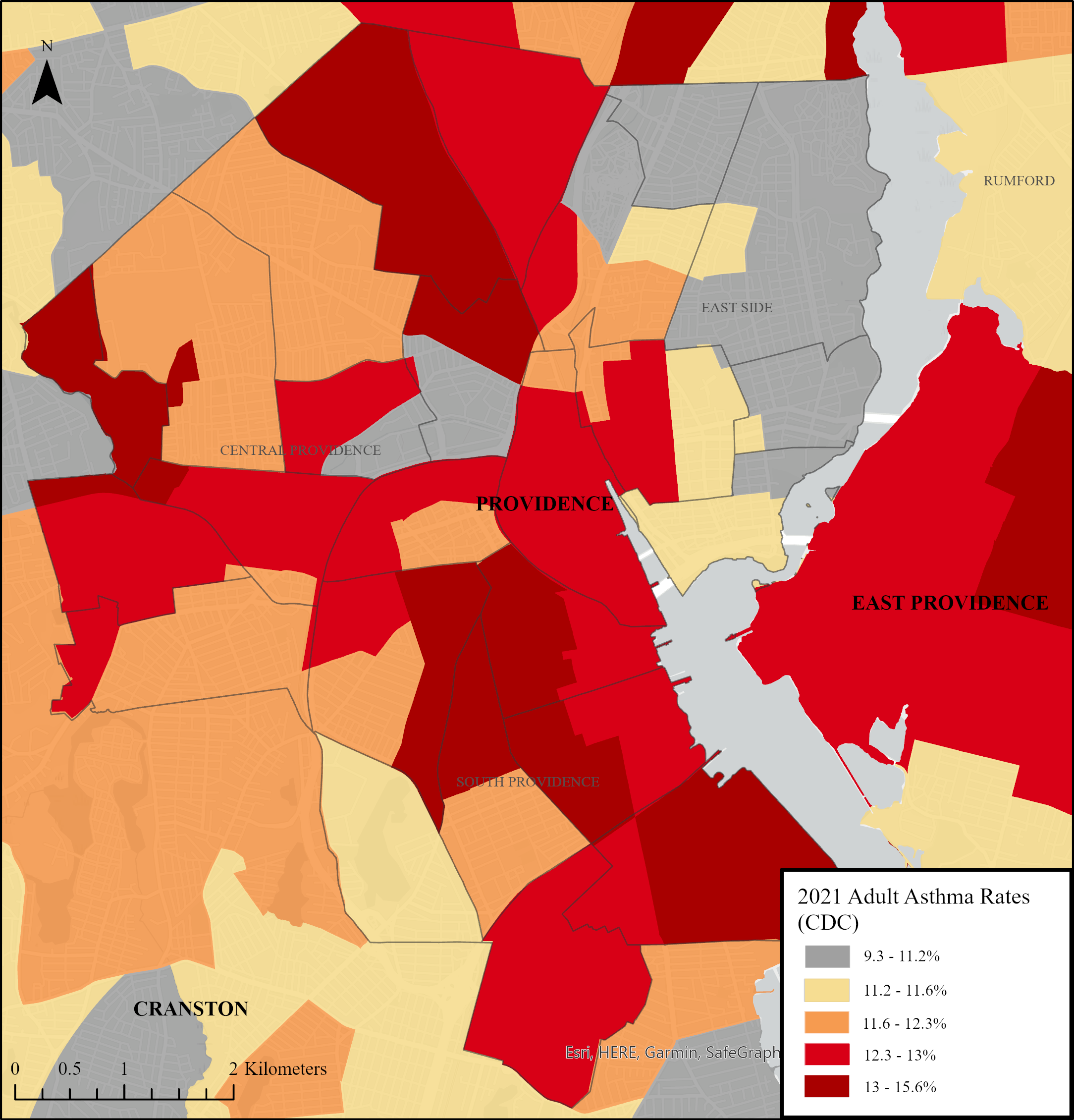
As of 2021, the Centers for Disease Control and Prevention reports that Rhode Island has the highest rate of asthma in the country, with 12.6% of the adult population suffering from the disease. The map to the right depicts adult asthma rates across Providence. See the RI Department of Health’s asthma page for more data.
Those most affected also tend to be people of color, children, and the elderly. Scroll down to learn more about Rhode Island’s asthma problem from RI KIDS COUNT and the RI Department of Health.
-
“The mission of Rhode Island KIDS COUNT is to improve the health, safety, education, economic well-being, and development of Rhode Island's children with a commitment to equity and the elimination of unacceptable disparities by race, ethnicity, disability, zip code, immigration status, neighborhood, and income.“
The Children with Asthma Factbook notes that children visit the emergency room for asthma far more than adults do. Asthma is also the third leading cause of hospitalization for children under 18 years old and is a leading cause of school absenteeism.
Rhode Island has the 5th highest self-reported child asthma prevalence among the 29 states who contributed statistics.
Asthma also tends to affect people differently based on race. In Rhode Island between 2016 and 2020, Black and Hispanic children under the age of five were the most likely individuals to visit the emergency department or be hospitalized as a result of asthma.
-
Though RIDOH’s Burden of Asthma report was published in 2014, the trends it highlights remain true today.
The report notes that, in Rhode Island, adult asthma rates are significantly higher among those with less than a high school diploma than among adults with a high school diploma or more years of formal schooling. Rhode Island asthma prevalence also is significantly higher among adults with household incomes below $25,000 than adults with higher household incomes.
In addition, approximately 13% of Rhode Island children have been diagnosed with asthma at some point in their life, and approximately 9% of Rhode Island children currently have asthma.
Asthma hospitalization rates have also been significantly higher for Black children in Rhode Island than for white or Hispanic children.